The Toothless UN: An Examination of Inaction and Budgetary Constraints
UNITED NATIONSTOOTHLESS
Jon Dory
4/28/20268 min read
Introduction: UN's Declining Influence
The United Nations (UN) was established in 1945 with the core mission of promoting international cooperation, maintaining peace, and fostering security among nations. The organization was designed as a platform where countries could come together to discuss and resolve their disputes without resorting to war. Throughout its history, the UN has played a pivotal role in conflict resolution, humanitarian efforts, and establishing norms of international law. However, in recent years, there has been growing criticism regarding the effectiveness of the UN in addressing pressing global challenges.
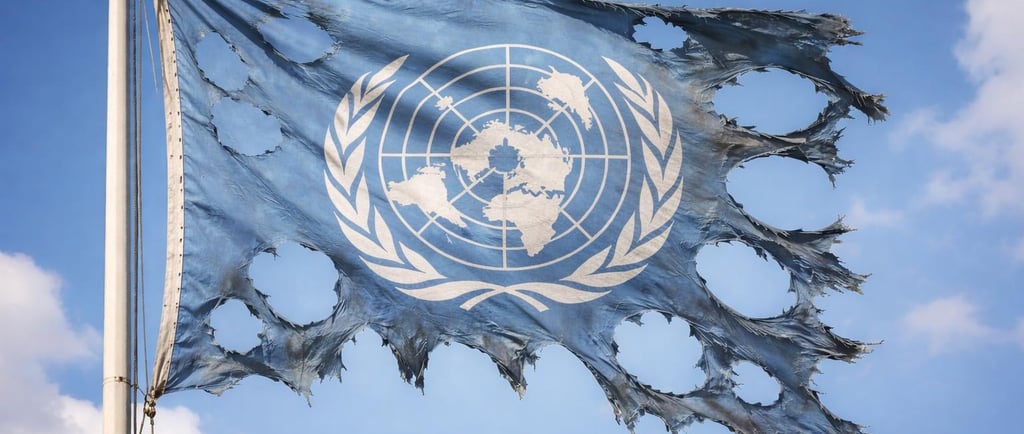
In 2019, Cyril Ramaphosa, the President of South Africa, famously referred to the UN as becoming 'toothless,' a statement that resonates with a broader sentiment regarding the organization's diminishing influence in world affairs. This characterization suggests that the UN's mechanisms for enforcing decisions and maintaining order among nations have weakened, leading to a perception of ineffectiveness in the face of complex global crises. The calls for reform have intensified as traditional power dynamics shift, with emerging economies seeking a more equitable representation in the decision-making processes.
The perception of the UN’s ineffectiveness can be attributed to several factors. These include its reliance on member states for enforcement of resolutions, budgetary limitations that impact its operational capabilities, and the politicization inherent in its structures. The inability to act decisively in situations of conflict—evident in cases such as the Syrian Civil War—has led to frustration among member states and citizens alike. As we delve deeper into the challenges facing the UN, it becomes paramount to understand the consequences of this perceived decline on global governance and international cooperation.
Historic Failures: Case Studies of UN Inaction
The United Nations, established to maintain global peace and security, has encountered several critical moments where its inability to act decisively led to devastating humanitarian crises. These failures serve as stark reminders of the limitations faced by the organization, primarily influenced by political dynamics and budgetary constraints.
One of the most glaring examples is the Rwandan Genocide of 1994, during which an estimated 800,000 Tutsis and moderate Hutus were murdered over the span of just 100 days. Despite being aware of the impending violence, the UN peacekeeping force in Rwanda lacked the mandate and resources to prevent the massacre. International indifference and inaction resulted in one of the worst atrocities of the late 20th century, highlighting the dire consequences of neglecting humanitarian responsibilities.
Similarly, the ongoing Syrian Civil War, which erupted in 2011, showcases the UN's struggle to facilitate meaningful intervention in an ever-complex conflict. While the UN appointed special envoys and initiated peace talks, the lack of consensus among member states regarding military intervention and support for opposition groups has stalled effective responses. As a result, millions have suffered—over 500,000 fatalities and over 11 million displaced. This failure to act decisively has perpetuated the humanitarian catastrophe, leading to one of the largest refugee crises in history.
In addition, the humanitarian crises in South Sudan and Yemen illustrate the consequences of inaction. South Sudan's civil conflict and subsequent famine have left millions at risk of starvation, while in Yemen, the ongoing conflict exacerbated by a blockade has resulted in widespread malnutrition and preventable diseases. Both situations reflect a stark absence of robust intervention from the UN, constrained by political will and insufficient funding for effective peacekeeping missions.
These cases exemplify not only the tragic outcomes of UN inaction but also underline the importance of robust international cooperation and the allocation of necessary resources to address global crises effectively.
The United Nations (UN), as a global institution, often finds itself in situations where it must respond to acts of violence and human rights abuses. Frequently, these responses take the form of verbal condemnations, which serve as an expression of disapproval but lack the necessary follow-through that can lead to meaningful change. Historical examples illustrate that such condemnations have frequently fallen short of achieving their intended impact. For instance, following the outbreak of conflicts in Syria and Yemen, the UN issued numerous statements denouncing the violence; however, these verbal condemnations were insufficient to alter the trajectory of the conflicts or to protect the affected populations.
Condemnation alone does not exert any tangible pressure on violators of international norms. In instances where dialogue and punitive measures may be necessary, the UN’s reliance on words may inadvertently embolden aggressors. The use of strong language may come across as an empty gesture when there is a lack of subsequent action, which ultimately undermines the credibility of the organization. Furthermore, the continued use of such approaches can foster cynicism among the global populace regarding the efficacy of international governance, as many perceive the UN's responses as inadequate in terms of catalyzing tangible reforms.
In contrast, a more proactive and actionable approach is pivotal for the UN to fulfill its foundational mission of maintaining international peace and security. Rather than merely voicing condemnation, the organization could explore avenues for intervention that involve diplomatic negotiations, peacekeeping missions, or sanctions against offending states. A more balanced application of rhetoric and action may enhance the UN’s effectiveness, contributing to the resolution of conflict rather than prolonging it through mere verbal disapproval. The urgent need for meaningful action underscores that while words can raise awareness, they cannot replace the necessity of decisive actions in promoting peace and stability in volatile regions.
Focus on Humanitarian Aid: The Case for Restricting the UN's Role
The United Nations (UN), comprising various specialized agencies, has a critical role in addressing global issues. However, there exists a significant argument suggesting that the organization may achieve more impactful results by concentrating exclusively on humanitarian aid rather than striving to mediate intricate political disputes. Initiatives like the World Food Program serve as exemplary models of the UN's potential when focused on alleviating human suffering.
Focusing on humanitarian aid can lead to a more enhanced reputation for the UN. By providing essential materials such as food, medical assistance, and education to vulnerable populations, the organization can demonstrate its commitment to the fundamental principles of human dignity and welfare. This focus not only fosters goodwill among nations but also enhances the credibility of the UN as a legitimate advocate for global humanitarian needs.
Moreover, a refined mandate emphasizing humanitarian efforts would streamline resource allocation within the organization. The UN often faces budgetary constraints that limit its efficacy in various areas, including peacekeeping and political mediation. By designating a significant portion of its resources to humanitarian projects, the UN can optimize operational effectiveness and reach those in desperate need of support. Humanitarian initiatives frequently yield measurable outcomes, thereby justifying the allocation of funds and leading to better management of the UN’s finite resources.
In this sense, narrowing the UN's role to prioritize humanitarian endeavors could provide a critical pathway for improving the lives of individuals affected by crises. The benefits of focusing on humanitarian aid extend beyond immediate relief; they also position the United Nations as a beacon of hope in an increasingly complex international landscape, fostering resilience and recovery in communities around the globe.
UN Budget and Contributions: Transparency and Accountability
The United Nations (UN) operates on a unified budget that encompasses various programs and initiatives aimed at fostering international cooperation and ensuring global peace. As of the 2022-2023 biennium, the total UN budget is approximately $3 billion, which is allocated across regular operations, peacekeeping missions, and specialized agencies. A significant portion of this budget is earmarked for sustainable development goals, humanitarian assistance, and international health initiatives.
Understanding the UN's financial structure requires a thorough examination of member state contributions. The financial commitment of each member state, guided by their economy size and capacity, directly impacts the overall budget of the organization. The United States, as the largest contributor, accounts for roughly 22% of the regular budget, followed by countries such as China and Japan. Conversely, smaller nations contribute a smaller percentage, which can challenge the equitable distribution of resources needed for effective operations.
These contributions reflect not only the financial capability of each member state but also their political priorities and diplomatic relations within the UN framework. The inconsistencies in contributions can lead to budgetary constraints that ultimately affect the UN's ability to implement programs and respond to crises effectively. For example, when notable member states withhold financial pledges or scale down their contributions, this can severely limit funding for critical peacekeeping missions and developmental initiatives.
Furthermore, transparency and accountability in the allocation of these funds are paramount for maintaining trust among member states and the public. The UN has made strides toward better financial reporting and openness, yet challenges remain in ensuring that every dollar is accounted for and used efficiently. A comprehensive understanding of the UN budget and contributions is therefore essential for recognizing the operational limitations the organization faces, as well as its potential for impactful global action.
The Global Impact: Consequences of a Toothless UN
The effectiveness of the United Nations (UN) in maintaining international peace and security has far-reaching consequences across the globe. A prescribed role of the UN includes mediating conflicts and fostering peace; however, when the organization is perceived as ‘toothless,’ the implications can be alarming and dire. First and foremost, an ineffective UN can lead to escalated conflicts. Nations may view the lack of assertive action as an opportunity to pursue aggressive policies without fear of international repercussions. Historical precedents illustrate that when the UN is unable to intervene decisively, violence tends to breed more violence. This scenario often manifests in prolonged armed conflicts that disrupt regional stability.
Moreover, the waning authority of the UN adversely affects the humanitarian landscape. Crises such as famine and refugee situations are exacerbated when the organization lacks the necessary resources and political will to intervene effectively. The refugees fleeing conflict zones often create additional stress on neighboring countries, leading to an overwhelming influx of migrants that can destabilize regions economically and socially. Such mass migrations frequently entail increased xenophobia, discrimination, and, at times, violent backlash against migrant communities.
Additionally, a ‘toothless’ UN contributes to a sense of global instability, diminishing trust in international institutions. This loss of confidence can incite countries to pursue unilateral actions that sidestep diplomatic resolutions. When states start retreating into nationalism or unilateralism, shared global challenges such as climate change and pandemics become even harder to tackle. Ultimately, the inability of the UN to act can lead to a decline in global cooperation, where states prioritize self-interest over collaborative efforts.
Conclusion: Rethinking the Future of the UN
The United Nations, once a beacon of hope for global cooperation, now faces significant challenges that hinder its ability to effectively respond to pressing international crises. Throughout this examination, we have identified key factors contributing to this ineffectiveness, including budgetary constraints, political inertia, and operational limitations. These elements not only compromise the UN's intervention capacity but also diminish its credibility on the global stage.
To move toward a more robust and responsive UN, it is essential to consider various pathways for reform. First, the allocation of resources must be revisited to ensure that the UN can effectively carry out its mandates. This may involve reassessing member state contributions to create a more equitable financial structure, allowing greater flexibility and responsiveness in crisis situations.
Moreover, streamlining the decision-making processes within the UN can facilitate swifter action in times of global emergencies. Empowering the General Assembly with greater authority in certain scenarios could enhance democratic representation and expedite responses. Additionally, fostering partnerships with regional organizations can provide invaluable support and localized insights that enhance the UN's overall effectiveness.
Finally, a comprehensive reevaluation of the UN's mission and objectives is necessary to align them more closely with contemporary global challenges. This includes confronting issues such as climate change, migration, and cyber threats with a renewed focus and collaborative strategies. As the global landscape continues to evolve, so too must the UN's approach to ensure that it remains relevant and capable of addressing the diverse needs of the international community.