The Echelon Network: A Modern-Day Surveillance Tool and Its Impact on Privacy
6/26/20262 min read

What is the Echelon Network?
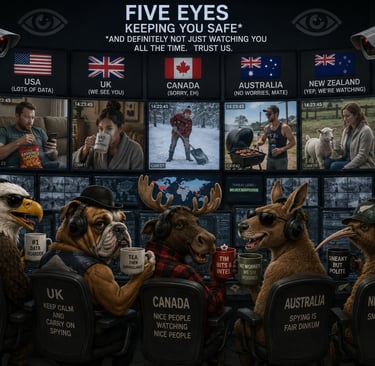
The Echelon network is a powerful global surveillance system developed during the Cold War, originally intended to intercept and analyze foreign communications. Operated by the Five Eyes alliance—comprised of Australia, Canada, New Zealand, the United Kingdom, and the United States—Echelon was designed to address international security concerns. However, in recent years, its scope has expanded, raising serious questions about privacy rights and the ethical implications of such surveillance.
How Does Echelon Violate Privacy Laws?
As the technology behind Echelon has advanced, so too has its capability to monitor vast amounts of data, often without oversight. What was once a tool for tracking foreign threats has evolved into a mechanism for surveillance of private citizens without their consent. This predilection for gathering data can lead to potential breaches of privacy law, as citizens unknowingly become subjects of scrutiny.
What complicates matters further is that many democratic nations have established privacy laws meant to protect citizens from unwarranted invasions of privacy. Yet, the very existence of Echelon creates a loophole. Under the guise of national security, governments can justify invasive surveillance practices, often sidelining the constitutional rights of individuals.
A Cold War Tool in a Modern World
The crux of the issue lies in a paradox: a system designed to detect foreign threats is often turned against citizens today. This shift in focus raises ethical questions about the justification of such measures under the pretext of protecting national security. As technology continues to evolve, the methodology of data collection becomes increasingly sophisticated, making it more challenging to regulate.
Due to the mass collection of data through the Echelon network, innocent individuals’ communications are often swept up in the collection net. Reports have suggested that this occurs without sufficient checks and balances, which is particularly concerning in democratic societies that value personal freedoms.
There is a growing outcry from privacy advocates and civil rights organizations, urging transparency and accountability regarding Echelon's operations. They argue that the public deserves more than reassurances about national security; they advocate for a robust dialogue about privacy and the rightful limitations of government surveillance.
Ultimately, the Echelon network serves as a stark reminder of how technological advancements can sometimes infringe upon civil liberties. While the intentions behind such surveillance may be to secure a nation, the implications for individual privacy can be detrimental. Striking a balance between security and privacy is not just prudent; it is imperative in safeguarding the democratic ideals that many societies hold dear.