Are the US and China actually at war?
How Taiwan, and a spoof GPS signal from the 90's contributed to the current war in Iran and beyond.
OIL WAR
5/6/20265 min read
Back in the 1990's China learnt a profound lesson it would never forget.
Such was the magnitude of this event, China called it 'unforgettable humiliation' and has continued to develop a solution to this very day.
China's problem?
Actually, there were two main problems:
GPS. The only global positioning system on the planet at the time was owned by the United States Government. From a Chinese perspective, this was clearly problem number one.
Although China wasn't aware of this at the time, problem number two began when the US Government implemented a policy of selective availability [SA] for GPS.
They secretly degraded the accuracy of civilian GPS signals worldwide—not just in China. This meant civilian users (including in China) got less precise positioning, while U.S. military users retained full accuracy.
Further, it seemed the US could manipulate this system at will, causing those using GPS to have wildly different coordinates than their actual position.
This gave the US military a strategic advantage that had not existed before, and it was simply a matter of time before this GPS saber would be wielded.
During the 1995-1996 Taiwan Strait Missile Crisis, China [known then as the People's Liberation Army], was 'testing' missiles toward Taiwan when it lost track of a number of the missiles. The incident was clearly intentional and a result of the US restricting the GPS to manipulate the situation, and embarrass the Chinese.
It obviously worked, as China later referred to it as 'unforgettable humiliation' [serious words for the Chinese] and immediately began working on a solution.
Fast forward to today, and China's solution to the problem is so elegant, it has now reshaped the world of geopolitics, technology, global infrastructure and of course, warfare.
China's solution?
BeiDou 3. A Chinese owned Global Positioning System named after the the Chinese word for the Big Dipper constellation. This system has been deemed by experts the best and most advanced system on the planet.
Fully operational in 2020, it has 35 satellites compared to the US global positioning system of 24.
BeiDou has three separate kinds of satellite orbits, compared the USA's single orbit system. This improves coverage in previously harder to reach places, especially where large buildings or mountainous areas and oceans used to deteriorate the signal.
Operating not on a singular but dual frequency enhances performance and accuracy. This feature also makes it much more difficult to jam.
In terms of accuracy, BeiDou is easily 3-5 times more accurate than standard GPS, and it also allows two-way text messaging in areas where mobile phone coverage doesn't exist.
In short, BeiDou is not a system designed to catch up with the American GPS - it designed to outperform it, in every way.
Now, over 140 countries are using the system to reduce dependence on the US equivalent.
Pakistan already uses it for military systems.
China is leading a challenge against US monopoly on many fronts, technology leadership is just one of the many.
So what can we take away from this? One of the most important points: China is incredibly focused to realize their ambition through strategic, long term planning.
In sports terms, 'they play the long game'. The BeiDou system is proof of this ethos.
In "The Art of War", Sun Tzu taught preparation for war is a meticulous, proactive process focused on securing victory before any combat.
War? Really? Who says China wants a war?
The reality is that China doesn't want a war, but they are preparing anyway. And why not?
The US has become increasingly belligerent in its approach to China, and, China will not forget the humiliation suffered.
This does not mean China is about to start lobbing bombs on the US. China is a far too cautious and strategic for such a foolhardy endeavor. [They leave this behavior to the Americans].
In reality, China will simply continue to prepare as if America is at war with them, whilst posturing the 'business as usual' approach to World media.
America is doing the exact same thing albeit in a more bombastic manner. Neither side wants to openly admit what is actually cooking.
However, if one were to look at recent US posturing, particularly with tariffs, and seriously erratic messaging coming from the White House, a realization that the two sides are already engaged in warfare could result.
100% tariffs from the US on Chinese Electric Cars. 50% on solar cells and an average of between 30%-47% in total. The Chinese now know this is a moving target, because the figure can change without diplomacy at any time.
To further stoke the fires of war, both countries are actively engaged in a space race, an AI race, a tech race, and a battle for currency domination.
Then there's Iran & Venezuela. Both targets of recent US aggression. Iran, twice in 8-months.
In January 2026 the US kidnapped then President of Venezuela, Nicolás Maduro, in an operation ostensibly around issues of narco-terrorism.
In truth, the operation was a way to get Venezuela to 'rethink' their energy alliances as the story has changed to since.
Prior to Maduro's removal in January, China was purchasing roughly half (50%) of all Venezuela oil exports. (400,000 to 470,000 barrels per day)
Almost immediately after Maduro's capture the US announced billions of dollars in spending to fix the oil infrastructure in Venezuela. [See video 1 below]
Donald Trump has since said, 'We have a great relationship. We have hundreds of millions of barrels of oil coming out of Venezuela'
Not sure where Trump gets his numbers, because Venezuela's total output is only around 900,000 barrels per day. However, if such a statement were true, the US must be taking ALL the export oil from Venezuela.
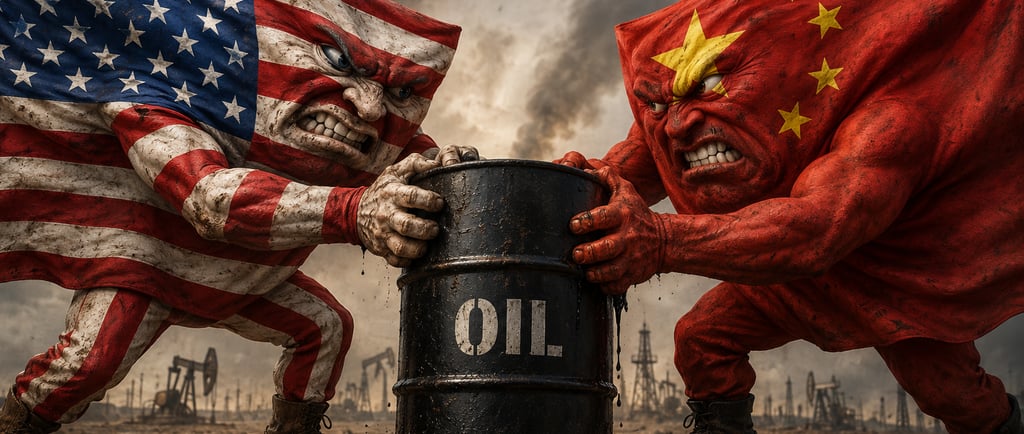
Clearly it's about the oil, and not letting China get it.
On to Iran, another major oil exporter who seems to find themselves on the receiving end of American hostility. Prior to the June 2025 US bombing in Iran, it supplied China directly with about 1.4million barrels per day (13% of China's total oil import).
Following June 2025, Iran deepened its strategic and economic dependence on China. China became an economic lifeline purchasing 80-90% of ALL Iranian oil. The US has since gone back to war with Iran, and also famously blockaded the blockade. The blockade stops the Iranian oil going where?
Clearly the Iran war is about oil partnerships, just like in Venezuela.
The US wants to deprive the Chinese economy of cheap energy that it uses for its continued growth. All these purchases are settled in Yuan, not the once dominant US dollar as China's currency presses against the greenback.
It's difficult to make a case for Iran's nuclear ambitions being the "sticking point" in this latest war.
Trump triumphantly told us in June 2025 'Iran's key nuclear facilities have been completely and totally obliterated'. [See video 2 below]
Yet, the US went back to War with Iran only 8-months later under the same premise.
These hostilities are nothing to do with Iran's nuclear ambitions, or Venezuela getting shipments of drugs into America - it's a protracted war with China that has been in the making since the 'unforgettable humiliation' in the 90's.

